
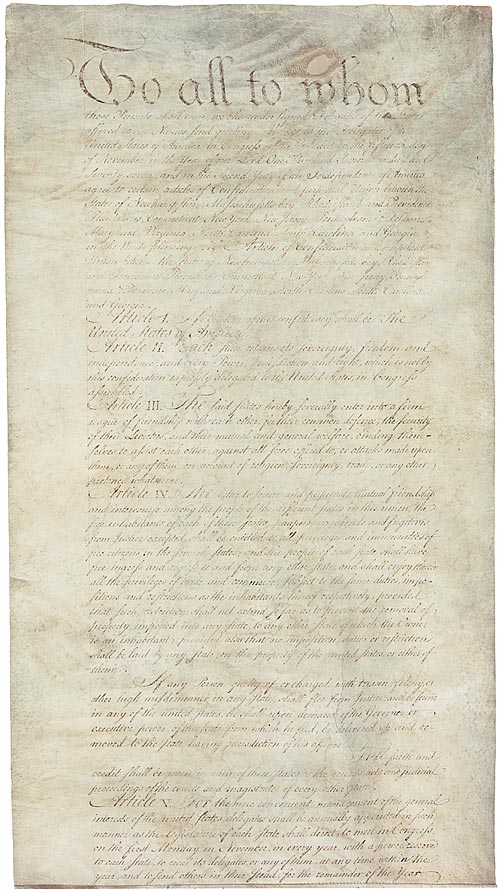
The American Revolution was driven by a number of factors, prominent among which were the perceived tyranny of the British, the presence of redcoats everywhere, and high taxes by the British Parliament—which led to the phrase “no taxation without representation” being coined. These grievances led to a number of actions, from the Olive Branch Petition, to the Boston Tea Party, and eventually, the American Revolution itself. The Battle of Lexington and Concord began when British troops marched on colonial militia rumored to be drilling with guns. The redcoats attempted to take the guns peacefully, but after the first shot occurred, the fuse was lit and the Revolution began. Yet, the colonies faced a great many challenges in the fight against Britain. The disorganized militia generally couldn’t fight on an open battlefield with the trained British—arguably the greatest army in the world. Even when the redcoats were under threat, their navy was able to ferry them out of the area. However, the lessons learned from the American Revolution did not necessarily carry over into the Articles of Confederation (AoC), though the factors that caused it remained. The Articles of Confederation was not a complete failure; while in a number of areas it failed to create a strong or effective federal government, it acted as a stepping stone for the later Constitution, and its stance on the West carried over directly.
The Articles of Confederation were created at a time when unity was the main requirement. Following the Treaty of Paris and the conclusion of the American Revolution, the creators of the AoC had to unite 13 colonies that were not all similar, many with competing wants, needs, and ambitions. Yet, the fears and grievances that led to the American Revolution remained. As a result, the AoC was effectively a series of compromises combined with severe limitations on the federal government’s power that rendered it powerless. The fear of tyranny and each state’s desire to maintain its independence is clear in the distribution of powers. The central government was not allowed to print money, levy taxes, maintain a standing army, or even order states what to do. Instead, the states printed their own money, levied taxes (sometimes on each other), and maintained militias that in times of war would combine to make an army—following the model of the American Revolution. Yet, this created issues almost immediately, as conflicting economic policies led to friction within the new nation.
That period would certainly be considered a recession, if not a depression, by modern economic standards. The lack of a standing army also left the United States vulnerable to attacks by Native Americans and pressure from European powers including Spain and Britain. Therefore, in terms of defense and economic policy, the Articles of Confederation can be considered a failure.
Yet, the AoC did have certain portions that could be considered a win, or at least not a loss. Foremost among them was policy regarding the West. The AoC’s stance and wording on this were largely carried over to the new Constitution through the Northwest Ordinance and other policies. This remained largely unchanged because grievances with the AoC generally did not target western expansion. Policy regarding the West was not the only thing carried over to the Constitution, but it is the only one widely considered an outright win. Two other areas carried over include policies on slavery and Native Americans. Regarding slavery, the Constitution did nothing to abolish it—the exact same stance taken by the Articles. This was due to the intense controversy surrounding the issue. Both documents faced a similar hurdle: securing ratification from all states. Including a controversial stance on slavery—at least for the South—would have doomed ratification. As a result, the Constitution simply kicked the can down the road for twenty years. Though the Constitution’s Three-Fifths Compromise broached the topic, it was meant to address census collection for determining House representation rather than establish a nationwide policy on slavery.
The Articles of Confederation’s method of dealing with democracy could also be considered a structural flaw. The United States was the first modern nation to attempt republican government on a large scale, and the fledgling nation struggled in this regard. In contrast to the bicameral legislature present today, the AoC established a unicameral Congress where passing new laws required a supermajority of nine out of thirteen states. Each state cast a single collective vote determined by its delegation. Because state legislatures chose these delegates, members of Congress represented state government interests over individual constituents. This created a gap between everyday citizens and congressional voting. The nine-of-thirteen vote requirement also created immense obstacles when issues needed resolving. The creators of the AoC made laws intentionally difficult to change, operating under the belief that requiring a supermajority would foster unity. In practice, however, that policy simply resulted in a Congress unable to pass essential legislation.
Though the Articles of Confederation failed in several critical areas, it was by no means a complete failure. Its policy on the West proved effective and was carried directly into the Constitution. Yet, in powers essential to a nation’s basic ability to function, the AoC broke down. Fear of tyranny led its creators to render the federal government virtually powerless. It left economic and defense policy in the hands of individual states and established a legislative system prone to gridlock. Thus, while the Articles of Confederation failed in governance, its structural lessons paved the way for the United States Constitution.
- Articles of Confederation (1777)
- https://www.archives.gov/milestone-documents/articles-of-confederation
- Primary Documents in American History
- Library of Congress Document List
- https://guides.loc.gov/sb.php?subject_id=162830
- Diplomacy under the Articles of Confederation
- https://history.state.gov/departmenthistory/short-history/articles
- Articles of Confederation; 3/1/1781; Miscellaneous Papers of the Continental Congress, 1774 - 1789; Records of the Continental and Confederation Congresses and the Constitutional Convention, Record Group 360; National Archives Building, Washington, DC