
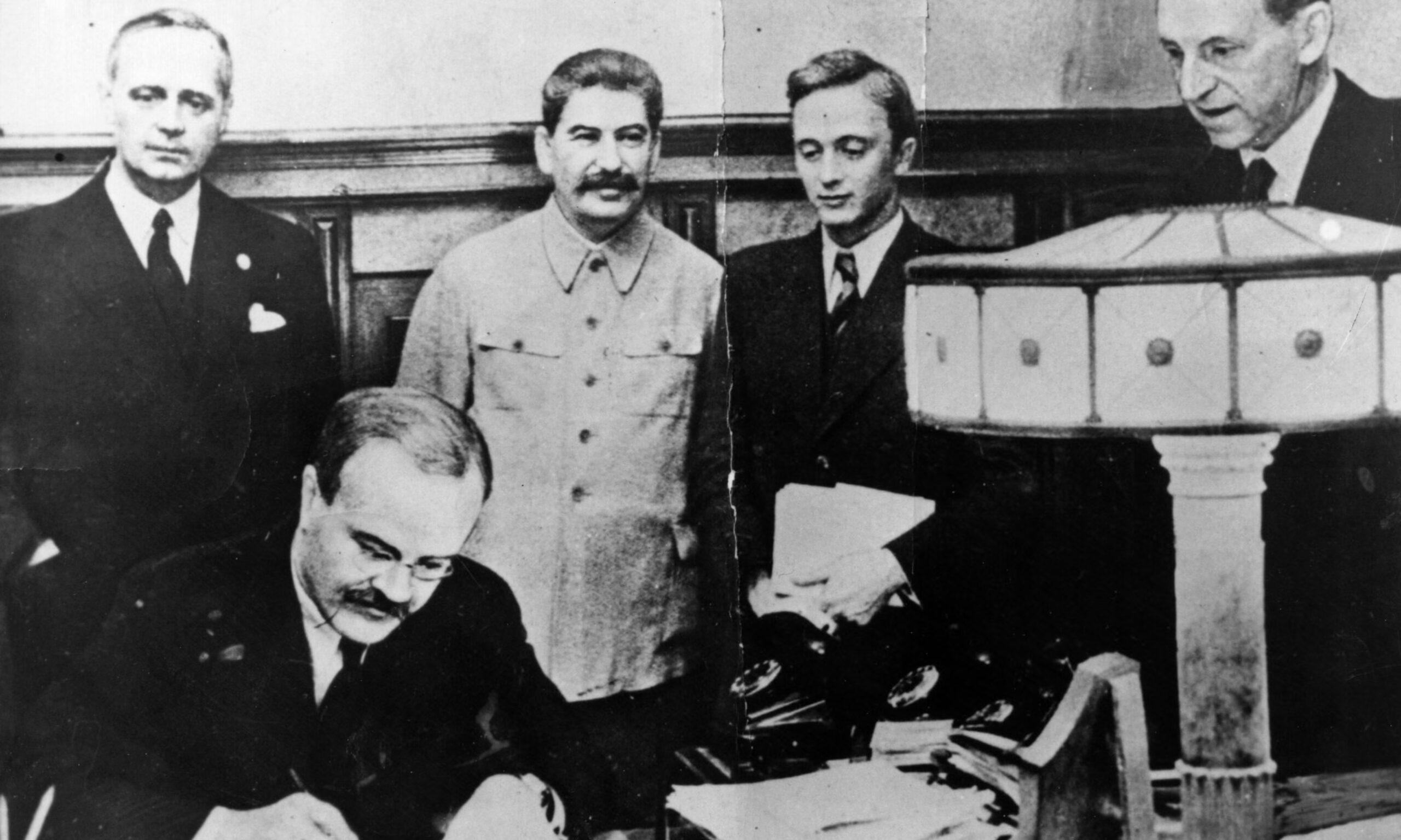
As the story goes, the Allied powers’ foolishness and insatiable desire to extract vengeance upon the German nation led to the Treaty of Versailles. Filled with clauses that forced the downtrodded Germany to pay reparations and essentially downgrade the nation from one of the strongest in Europe to a second-class people. It can be best exemplified by William. L. Shirer, who wrote in his book The Rise and Fall of the Third Reich, “An Englishman could walk into the heart of Berlin and strike a German on the face, and no one would dare to retaliate,” when describing the period of time during Adolf Hitler’s rise to power. Yet following the charismatic Austrian painter’s establishment of control over the nation and the unprecedented success in France, he signed the Molotov-Ribbentrop Pact — a peace treaty with the Soviet Union. So why did Hitler decide to sign this pact with a bunch of communists, by all means his mortal enemy?
As Hitler’s grip on Germany slowly began to grow, he began to ignore the Treaty of Versailles. He marched back into the demilitarized Rhineland, took Austria and Czechoslovakia (Czechia and Slovakia today), and began to rapidly modernize his military. The number of soldiers in the Wehrmacht (German Army) swelled and the Kriegsmarine (German Navy) began to pump out ships. This all came as he gained the support of the public. What one must understand is that the German economy was in tatters and the Great Depression combined with the Treaty of Versailles had deeply affected the citizens. Hitler therefore, was a ray of hope in this dark time. Under him, Germany boasted a whopping 100% employment rate (considering you, of course, don’t take the Jews, the women or any other minorities into your calculations). This allowed him to shore up alliances and build relationships that would protect his interests. This included a pact with his sworn enemy, the Soviet Union.
The Molotov-Ribbentrop of August 23, 1939 defied all logic. It guaranteed 10 years of complete nonviolence between Germany and the Union of Soviet Socialist Republics (USSR) as well as a promise from each nation to abstain from joining any coalition against the other. However, Germany had already broken this by joining an anti-Communist coalition (Anti-Comintern Pact) with Japan in 1936. This was an ominous foreshadowing of future events. The agreement further outlined, with a secret addendum, the political boundaries separating the two nations’ spheres of influence, including the division of Poland. It also established the sole use of diplomatic processes to handle any conflict that may arise between the two countries. The Pact, had in fact, achieved every single foreign policy initiative Stalin had outlined the same year. At least concerning Germany. It is worth to note that this was signed by the Soviet Chairman of the Committee of People’s Commissars Vyacheslav Molotov and the German Foreign Minister Joachim von Ribbentrop. Molotov later confirmed the USSR’s dire political situation to the legislative body of the Soviet Union only eight days later. Highlighting how negotiations with the French and British had failed, leaving the non-aggression pact as the best method for “ensuring peace and eliminating the danger of war between Germany and the USSR.” The driving reason behind this pact was due to the Soviet Union’s inadequate preparations. It bought the nation time to consolidate power, build military strength, and build international influence.
On the other hand, it was the Germans who had taken the first step, despite the numerous benefits that it would bring to the Russians. While it did help the USSR bolster its forces, it gave Adolf Hitler exactly what he wanted, free reign to invade Poland! However, the signing of this agreement begs the question, why did the Soviet Union need such defense in the international arena? The answer lies in Joseph Stalin’s paranoia and the purging of both the Soviet (Red) Army as well as the political and administrative leadership of the nation. Between 1936-1939, the most reliable estimates place the number of Russians who had either been killed or incarcerated by the regime to be around 4.5 million. This included around half of the Red Army’s officers, leaving the military in disarray. Those that remained were incompetent, inexperienced, disorganized and completely demoralized. The USSR’s viability was even questioned by the French government. Who reasoned that these purges must either reflect the instability of the Soviet Union caused by the apparent presence of innumerable traitors or that it was governed by a madman whose paranoia had prompted him to betray and execute his best generals and commanders. Hitler only benefited from this.
Not only did the Molotov-Ribbentrop provide military benefits to the Nazi regime, but also economic benefits. These took form in the German-Soviet commercial agreement of 1940, where the Soviet Union promised to supply Germany with resources in exchange for millions of Reichsmarks. While Stalin held up his end of the deal, feeding the Germany war machine, Hitler provided excuses for the delay in the payment. Ultimately never paying. The lack of Soviet retaliation for the missed payment is a snippet of the nation’s foreign policy towards Germany up until the subsequent invasion of the USSR. The Soviet premier, Joseph Stalin was unconvinced of any incursion by the Germans. To such extents was this belief that he disregarded both Soviet and allied intelligence warning of an impending invasion.
While Adolf Hitler certainly had an advantage going into the German invasion of the Soviet Union (Operation Barbarossa), he ultimately failed, with the invasion leading to his downfall. Hitler always had ambitious plans concerning the Soviet Union. As outlined in his book Mein Kampf, the USSR’s vast land and natural resources were critical to his vision, Lebensraum (living space in German). This word was used to describe the aggressive Nazi expansion for the Greater German Reich. He planned to replace those living in modern-day Eastern Europe, with German (Aryan) people. In the end, Operation Barbarossa — and thus Hitler’s east-bound aspirations — came down with a crash, with the Battle of Stalingrad as a turning point.
- 1 Alvin Rubinstein, The Foreign Policy of the Soviet Union (New York, Random House, 1960), 143-144. 2 Ibid., 142. Friends of Necessity: The Effects of the 1939 German-Soviet Nonaggression Pact
- Friends of Necessity: The Effects of the 1939 German-Soviet Nonaggression Pact
- https://affiliate.wcu.edu/tuckasegeevalleyhistoricalreview/spring-2020/friends-of-necessity-the-effects-of-the-1939-german-soviet-nonaggression-pact/
- The Rise and Fall of the Third Reich
- William L. Shirer
- Keystone/Getty Images