
July 17, 1942. A day which will forever live in infamy. The day on which a battle began. A siege that lasted 6 months. This battle, perhaps the most significant battle in Europe during World War II, was arguably the biggest turning point against the invincible Germans’ advance and shaped history for years to follow. The Battle of Stalingrad, which ended on February 2, 1943, took the lives of over a million soldiers.
To provide some context, World War II began with the German invasion of Poland on September 1st, 1939. Two days later, the British and French Governments declared war, sparking the deadliest war known to mankind. However, this war did not simply begin because of the whims of a dictator. Rather, it began with the end of World War I. In 1919, at the Palace of Versailles, a few miles outside of Paris, France, the leaders of the victorious allied nations came together to create peace for future generations. To accomplish this, they created the Treaty of Versailles. Many consider this the primary reason for World War II. In this document the European leaders of the central powers — Austro-Hungarian Empire and the German Empire — were forced to sign a paper which imposed measures upon these nations that significantly hampered their ability to wage war on another country. The harshest actions were taken against the German Empire. They were declared to be solely responsible for the war (untrue) and strict punitive measures were imposed. Their military might was heavily limited and parts of their empire were provided to other nations. Such were the measures that Germans were forced to deal with. This unrest created a storm that allowed Adolf Hitler to take control of the nation. That was what led to the war that took millions of lives.
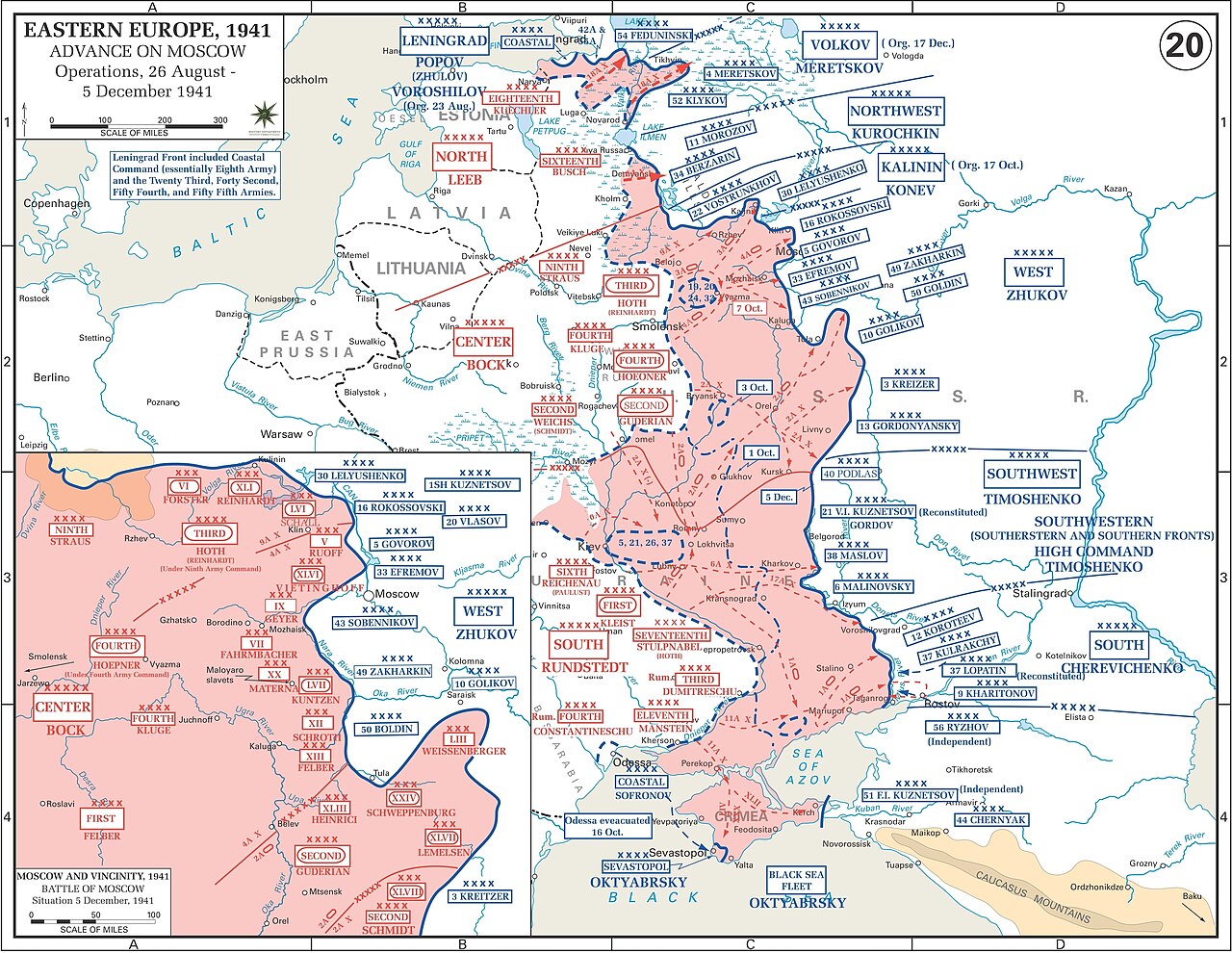
Operation Barbarossa (German for “Red Beard”) began on June 22, 1941 following the failed invasion of Britain. Wehrmacht (Nazi Military) leadership relied on various intelligence sources to support the planning. German military command knew that they would not be able to afford a protracted conflict with the large nation, the only problem being the Red Army. They hoped that the Blitzkrieg (lightning war) tactic that had worked so successfully in France and Poland would force Stalin to call for peace. The invasion was initially estimated to last between six to eight weeks. Instead, despite the early German successes, the operation lasted a grueling six months, leading to a full retreat along the Eastern Front (German – Soviet) for the Wehrmacht.
The question that is now present is why? Why did Hitler lose the war? The reason lies in the Führer’s decision making. He made several costly mistakes regarding the ends, ways, risks and targets of the operation. At the start of the operation, the vision was very clear. Take Moscow and the Red Army would fall. He also determined, against the advice of his staff, that Leningrad (modern-day St. Petersburg) and Kyiv were also to be captured. Towards the later days of the invasion, forces were diverted towards Stalingrad (modern-day Volgograd). This stretched the nation’s military resources, weakening the invading force.
This brings us to the objective of this essay. Stalingrad. A very simple statement can be used to sum up the entire battle. Adolf Hitler’s hubris led to the defeat of the Sixth Army (army attacking Stalingrad). Due to Stalin and the Red Army’s unpreparedness for a prolonged and intense conflict, the German forces were allowed to quickly advance hundreds of kilometers into the USSR, leaving them within striking distance of Moscow. However, problems were soon discovered. The German supply chains were hopelessly overstretched, the terrain was not suited for their armored vehicles, and Russian soldiers were showing greater opposition. This led to decreasing morale among the invading troops. As the Germans neared Moscow, Stalin finally listened to his generals and stayed in Moscow. The eventual push against German troops created the prelude to the attack on Stalingrad. The Soviets after all, had seemingly endless supplies of men for their forces and were pouring out tanks, planes and weapons in the eastern factories at a rate the Germans could never match.
In April 1942, assembling a small but still substantial force, Hitler aimed at the Caucasus oil fields in the south. Without oil, he said, we cannot win the war. Thus began the planning for Operation Blau. To command the vaunted Sixth Army of 330,000 elite troops, Hitler appointed a favorite, General Friedrich Paulus. An exceptional staff officer, Paulus had never led a field army. A problem emerged as they began though, General Paulus, intimidated by Hitler, was unable to stand up to him. During July and August, the force destroyed 7,000 tanks, 6,000 artillery pieces and 400 aircraft. Along with taking 625,000 Soviet troops prisoner. On July 9, an overconfident Hitler ordered the Sixth army to separate from the Fourth Panzer Army. The orders were to swing east and take Stalingrad. Cutting off the supply chain to the Volga (key river) and taking a major political target. Despite brave fighting and huge casualties, the Russian forces slowly retreated. Denying the Germans the total victory that they sought. Defending even more desperately as they fell back to Stalingrad, they dug in. It was at this point, on 28 July, that Stalin issued Order 227 – “Not a step back! (Ne shagud naza!). Each position, each meter of Soviet territory must be stubbornly defended, to the last drop of blood. The invasion was presented as a historic war to save the USSR, calling on nationalistic sentiments by replacing the words Soviet Union and communism with Russia and motherland. Stalin also refused the evacuation of citizens, stating that the troops would fight harder knowing there were residents in the city. By issuing this order, Stalin had committed himself, the Red Army, and the Soviet nation, to one of the most terrible battles in world history.
After reaching the Volga (river near Stalingrad), German confidence rapidly declined. The Soviets were showing greater resilience – a product of Stalin learning to trust his generals – while the Germans made increasingly bad military decisions – due to Hitler alienating himself with his general staff, demanding total obedience – leading to the Soviet victory. While the Germans initially had massive advantages in technology and air superiority, as the battle waged, the fighting descended into Rattenkrieg (rat’s war in German, used to describe urban combat). The Soviets and Germans were continuously fighting for control of hills and other vantage points. While the Germans would capture a building during the day, the Soviets would sneak in through the basements during the night. It was bloody and brutal warfare. As the Sixth Army slowly burned through its supplies and with reinforcements turned away, they were at their ropes end. It was at this point that Paulus’s inability to argue with his leader created consequences for his troops. With his troops demoralized, supplies low and completely surrounded, he was forced to defy Hitler. On February 2nd, 1943, Field Marshal Paulus’s Sixth Army, surrounded and beleaguered, were forced to surrender.
This battle, the battle of Stalingrad proved to be the turning point of the German advance into Russia. Already pushed back from Moscow and a tiring siege at Leningrad (St. Petersburg), the psychological impact of the loss halted the string of German victories heading into the summer of 1943. With this triumph, the Soviets not only wiped out an entire army, but created a hole in the Wehrmacht line which they used to push the invaders back. After this, German troops lost the strategic initiative, slowly retreating while losing major battles. Along with the steady re-armament and reorganization of the Red Army as well as better technology, it was now the Germans who were attempting to escape. Immediately after the battle, the USSR launched an offensive against the German troops in the south-western area of the nation. A string of operations simultaneously attacked the beleaguered Germans, attacking and attempting to capture Wehrmacht general Erich von Manstein’s army group. However, his army managed to escape the trap, quickly retreating to safer lines. Soon after, with a steady advance from the Soviets, the Germans planned a massive attack at Kursk to hopefully turn the tide. However, after word was leaked to the Soviets, they dug in and counter-attacked with their own armored divisions. This led to the Battle of Kursk – the largest tank battle in history – which was the beginning of the end for German aspirations to the east. A point to be made is that while the failures Operations Barbarossa and Blau did significantly change the tide of the war, the Wehrmacht still remained a formidable fighting force. It took the Soviet Union 2 more years following the Battle of Stalingrad to reach Berlin.
Following World War II, the Soviets took hold of many of the nations in Eastern Europe – these nations were captured by the Soviet Union during their push for Berlin – and placed communist puppet governments in them. These countries formed the Eastern Bloc, a buffer zone between the capitalist west and the communist USSR. This battle, mainly between the US and the USSR, was called the Cold War. Its influence continues to shape our world today.
- Stalingrad 1942: The Aftermath
- https://www.thehistoryreader.com/military-history/stalingrad-1942-aftermath/
- Russia commemorates pivotal Battle of Stalingrad
- https://www.reuters.com/article/world/russia-commemorates-pivotal-battle-of-stalingrad-idUSDEE91103N/
- Operation Barbarossa: A Lesson in Hubris and Strategy
- https://www.armyupress.army.mil/Journals/NCO-Journal/Archives/2022/May/Operation-Barbarrosa/#
- Stalingrad: The Hinge of History—How Hitler's Hubris Led to the Defeat of the Sixth Army
- https://jmvh.org/article/stalingrad-the-hinge-of-history-how-hitlers-hubris-led-to-the-defeat-of-the-sixth-army/
- Case Study #1 - Stalingrad
- https://mwi.westpoint.edu/urban-warfare-project-case-study-1-battle-of-stalingrad/
- The History Department of the United States Military Academy, Public domain, via Wikimedia Commons
-
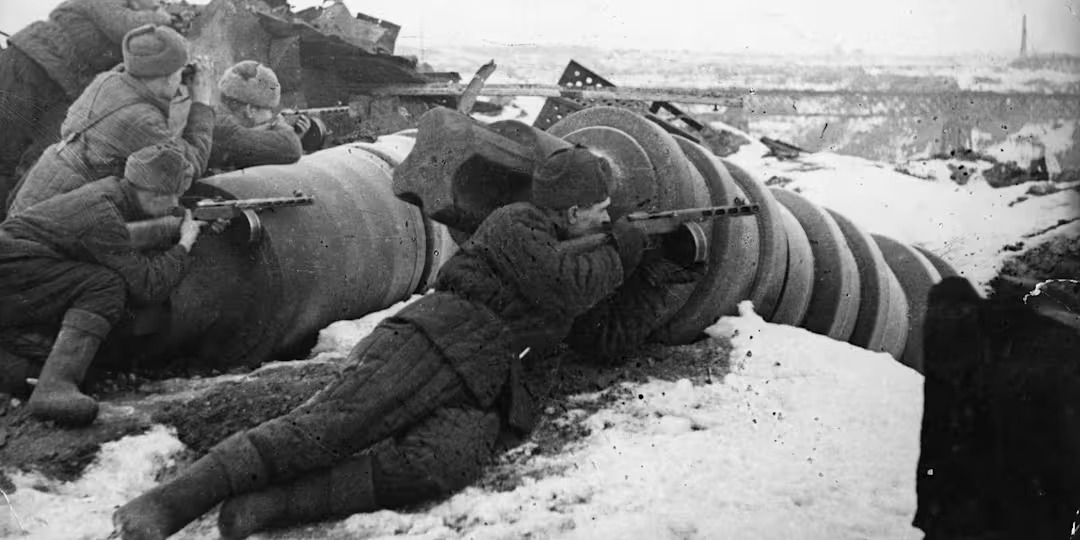
- Hulton Archive/Getty Images